Literature Review Tools, Note-Taking Strategies and AI tutorials for the modern academic. Publish more with less effort and supercharge your career.
Share
Google Scholar's AI Shift & updates to AI search tools
Published 4 months ago • 3 min read
Updates to The 3 Core Tools For Literature Search
Dear Scholar,
If you have been following me for a while, you might have heard of the "AI search loop." Given a question, this method is a thorough yet rapid way to find relevant scientific literature. Today's newsletter covers recent updates to all involved tools. Most interestingly, Google Scholar is now becoming an alternative to pricy AI tools. (See below what it means for the big picture.)
Here's how the search loop works: Based on a plain-text question, you use Consensus or the new Google Scholar Labs AI feature to find a few seed papers. These results are highly targeted, but typically yield only 2-3 relevant papers. This is why in the next step, you use Litmaps or ResearchRabbit to dig into the references of these first few papers to find additional literature based on the reference network (i.e. who cites whom). The combination of AI and reference network is what makes it so powerful. Here is a schematic:
The tools I have been using for this recently saw substantial updates. Even Google Scholar now has an AI mode.
Here is what's new with each tool (Click the links to get to the article):
🔹 Update 1 - Consensus: Recently introduced deep-search (i.e. AI mimics the systematic review process), full-text PDF analysis and an easier way to access abstracts. I use this tool permanently during the writing phase of my papers.
🔹 Update 2 - Google Scholar Labs: This is Google's AI update for the popular Google Scholar search engine. It features a chat interface and provides answers based on source text, making it a free alternative to paid AI tools like Consensus.
🔹 Update 3 - Litmaps or ResearchRabbit: These were two separate tools before Litmaps acquired ResearchRabbit in May 2025. ResearchRabbit received a redesign (in the style of Litmaps), while Litmaps seems to have been halted. While I still stick with Litmaps, you can use either tool.
Outlook: Google converting its Scholar search engine into an AI chat sends a message: Searching for literature and then reading papers to get answers is a thing of the past. Instead, researchers will get answers directly based on sources AI finds and evaluates internally; in cases where it matters, humans will read to double-check AI, making us faster, but also more reliant on AI models.
What do you think of that?
I recently made a video on AI ethics and why this worries some people. Please comment to join the conversation!
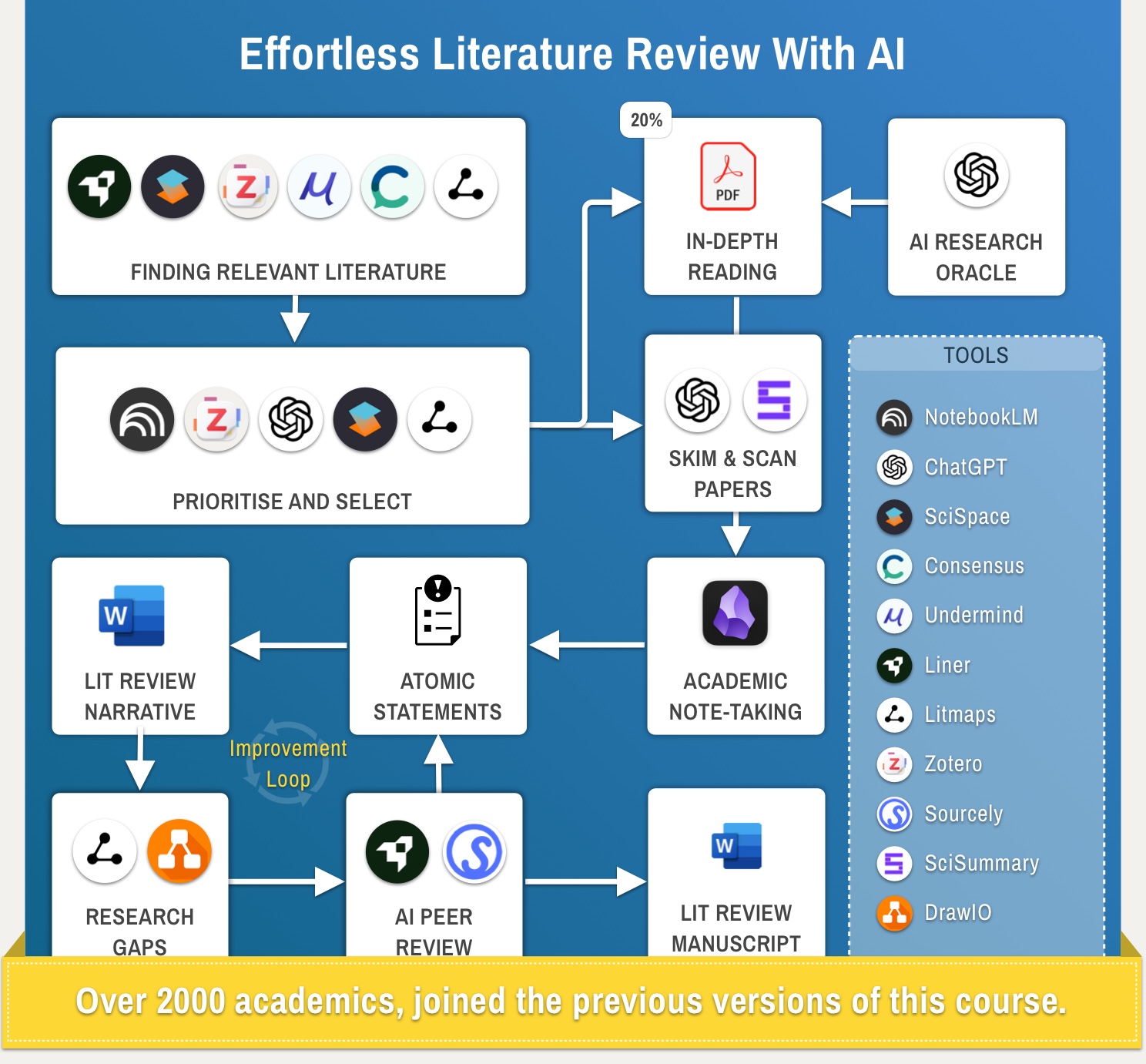
All new Effortless Literature Review Course
If you have never heard of the "AI search loop", you are missing out on a lot of very recent technological developments that researchers can benefit from. Using these shortcuts is ethical, and since most researchers still don't know them, it can boost your career if your career depends on more or better papers/grants.
The Literature Review Course is the result of almost four years of experimentation with countless AI tools and workflows. The course tells you which tool is worth its money, how to use it, and how to combine it into a powerful workflow, resulting in faster paper publication.
If you are struggling with literature reviews or just want to spend far less time writing them, get the course, work through the materials, discuss your findings in the EA community, and start applying them to your work immediately. You can easily work through the material in a few days.
Just like I wrote 4 papers in the first 2 years of my PhD, while building a business and having time for health & hobbies, you can leverage these methods to become more productive, less stressed or as I call it: Effortless.
There are automated discounts of up to 60% for lower- and middle-income countries (blue banner at the top) and student discounts upon request, if you email me from your institutional address.
This is the weekly Effortless Academic Newsletter. It consists of an in-depth tutorial and additional events, promotions, or relevant information for the AI-curious modern academic. I strive to consistently provide value with every email. If this is not relevant to you, you can always unsubscribe from everything and will never hear from me again. If you find the email somehow inappropriate, please reply to me and let me know what you didn't like.
The Effortless Academic
Literature Review Tools, Note-Taking Strategies and AI tutorials for the modern academic. Publish more with less effort and supercharge your career.
Tool Review: Consensus 2026 for Lit Reviews & Writing Phase Dear Reader, Academics who use AI for academic writing typically fall into two camps: Those who try to do too much at once, generating whole paragraphs, and those who only occasionally ask for small corrections. One is ethically questionable and produces poor-quality output, while the other leaves a lot of potential on the table. Both require a lot of manual editing and don't make you all that much more productive. Having tried both...
Tool Review: Consensus 2026 for Lit Reviews & Writing Phase Dear Reader, I am wrapping up writing my PhD thesis and am currently 3 months ahead of schedule, with two papers accepted and two more in review. This feels good, especially as I will be able to dedicate much more time to the EffortlessAcademic. I think most students could do this if they master what almost nobody does: The combination of digital notes + AI. Here is why: A digital note-taking system, helps learning and remembering...
New Effortless Writing with AI WebinarApril 11, 2026 (+ Recording) Dear Reader, It seems easy to "write with AI", but fairly quickly, you realise 99% of AI-written text doesn't actually meet academic standards. Typically, the text is vague, overly verbose, or just plain wrong. Maybe you've been there? I've had this experience as well, which prompted me to push AI to its limits, to build a system that is ethical, personal, fact-checked, and produces writing tailored to academic needs. My main...